
Battery manufacturing and testing
Receive, test, grade and assemble real lithium-ion cells into a pack.
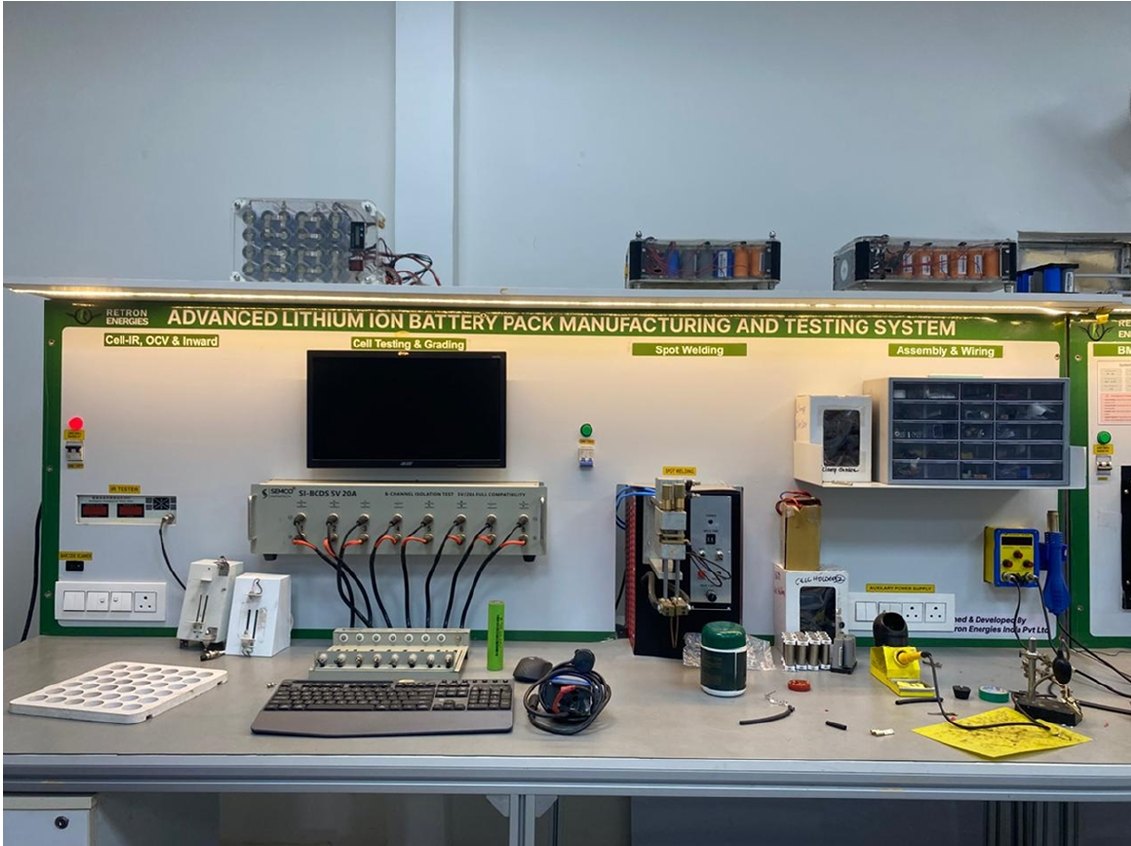
The significance of this zone.
Every EV battery pack starts as individual cells, and no two cells are exactly alike. This zone teaches students to receive, test, grade and assemble cells into a pack, with a record for every cell.
It is the foundation of the lab. The BMS, the charger and the vehicle all depend on a pack built from well-matched cells.
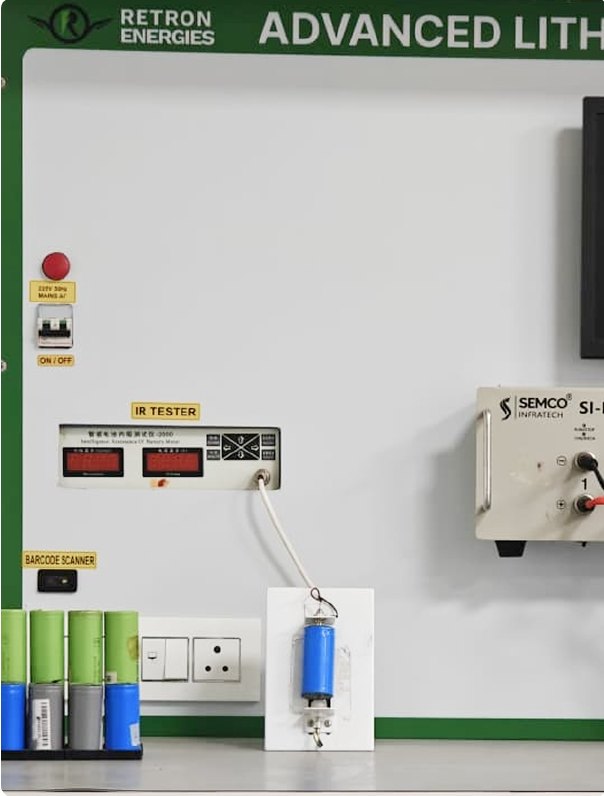
Scan and register cells with a barcode
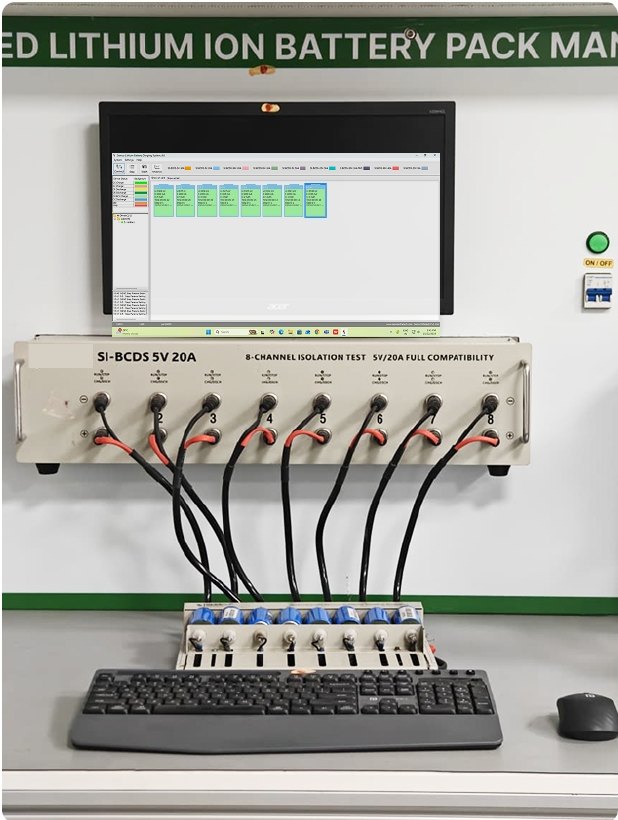
Test eight cells at the same time
Sort cells into A, B and C grades
Design, weld, solder and test a battery pack
What students can run here.
Cell reception and inventory
- Register each cell with a barcode and a storage location
- Create the cell's digital record in the Cell Testing Platform
- Follow a cell's history from arrival to deployment
Cell testing and grading
- Internal resistance (IR) and open-circuit voltage (OCV) tests
- Capacity tests on 8 channels, up to 5 V and 20 A per channel
- Sort cells into A, B and C grades
Pack building
- Pack design and series-parallel configuration
- Semi-automatic spot welding of cell connections
- Soldering with a temperature-controlled station
Pack testing
- Programmable charge and discharge, constant current and constant voltage, with rest steps
- Live graphs of voltage, current and capacity, with CSV export
- Thermal camera inspection of a pack under load
- BMS integration and a final functional test
Equipment and setup.
Equipment available
- 8-channel isolation cell tester (5 V, 20 A per channel)
- IR and OCV tester
- Barcode scanner
- Semi-automatic spot welder
- Temperature-controlled soldering station
- Programmable pack charge-discharge tester (0 to 99 V DC, 0 to 20 A, LAN)
- Thermal camera
- DC power supplies, electronic loads and digital multimeters
- Battery assembly workstation
Software
- Retron Cell Testing Platform (barcode, grading, audit trail)
- Pack test programming and data logging
Models and specifications are listed in your proposal.
How students move through it.
Learners start on the LMS and the AI simulator, then run the experiments on the bench.
Indicative curriculum. The final module list is confirmed in your lab proposal.Prerequisites
- No prior battery work is needed
- Basic electrical knowledge helps: voltage, current, series and parallel
- Safety briefing before the first experiment
- Safety and orientationLab rules, safe power-up and power-down.
- Cell reception and inventoryBarcode registration and cell records.
- IR and OCV testingMeasure and record the first quality checks.
- Capacity testing and gradingRun capacity tests and assign A, B or C grades.
- Pack design and assemblyChoose a configuration, weld and solder.
- BMS integrationConnect and check the protection board.
- Pack testing and reportingProgram a test, read the graphs, write the report.
What learners can do afterwards.
For institutions and for industry.
Colleges and training institutes
- A working cell-to-pack line for teaching
- Hands-on projects, not just demonstrations
- Test logs and reports that show practical work
Startups, SMEs and OEM teams
- Test and grade cells before a pack build
- Trace every cell back to its test results
- Train technicians on a production-style flow
- Trial a pack design before scaling up
Ask about the battery manufacturing and testing zone.
Tell us about your institution or project. We reply with the zone details, equipment list and a proposal.