
Charging emulator
Run charging sessions, inject faults and measure losses, without high-voltage risk.
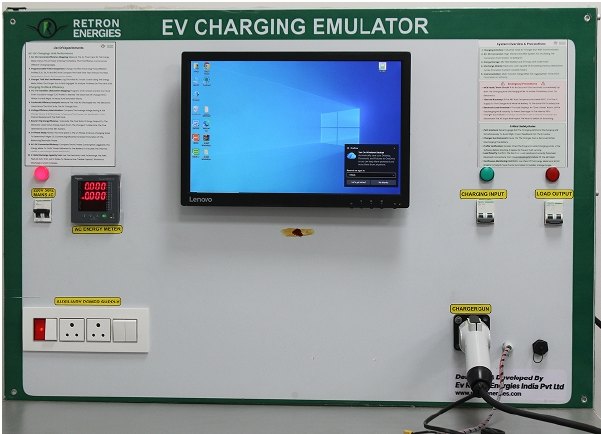
The significance of this zone.
Charging is where the battery, the BMS and the grid meet. Real chargers are high power and unforgiving. This zone emulates a battery pack so students can run charging sessions, inject faults and measure losses safely.
Students see how voltage rises, how current tapers and how state of charge is estimated during a charge.
Design custom charging curves
Compare CC, CV and CC-CV charging
Inject faults such as over-voltage and lost communication
Measure charge efficiency and power loss
What students can run here.
Charging profiles
- Constant current, constant voltage and CC-CV charging
- Dynamic charging with time-of-day and grid-signal simulation
- Multi-step automated charge sequences
Connector standards
- Type 2 (Mennekes), the global standard
- Bharat AC-001, the Indian standard
- Connector and protocol comparison
Efficiency and analysis
- Charge efficiency
- Coulombic efficiency
- Power loss with an energy meter
- Validate a SOC estimation algorithm
Safety and fault testing
- Over-voltage and under-voltage protection
- Over-current limit response
- Plug-out during a charge
Equipment and setup.
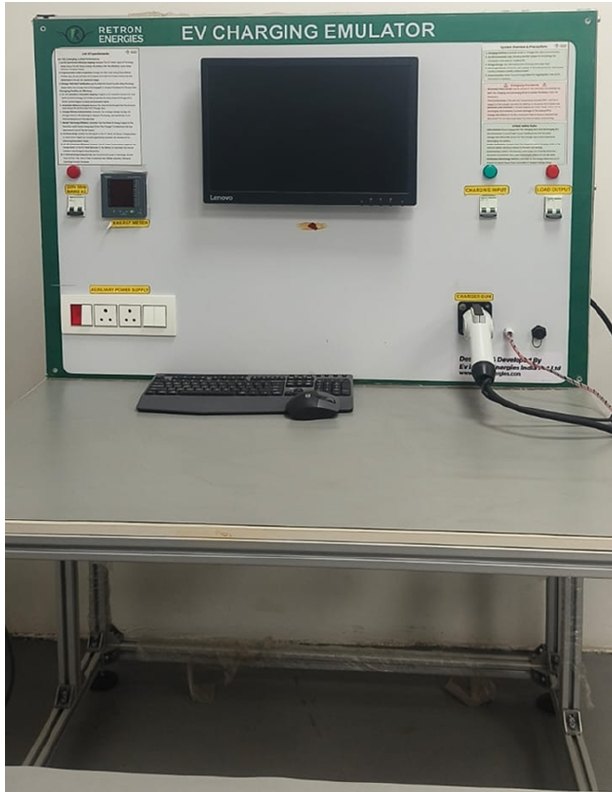
Equipment available
- Charging emulator with programmable profiles
- Charging connector inlet
- Energy meter
- Protection breakers
- Display and control PC
- Data logging for every parameter
Software
- Charging emulator control and logging software
Models and specifications are listed in your proposal.
How students move through it.
Learners start on the LMS and the AI simulator, then run the experiments on the bench.
Indicative curriculum. The final module list is confirmed in your lab proposal.Prerequisites
- No prior charging-system experience is needed
- Basic electrical knowledge helps
- Complete the safety module first
- Safety and orientationEmulator safety and lab rules.
- Charging fundamentalsVoltage rise, current taper and SOC.
- Charging methodsCC, CV and CC-CV profiles.
- Custom profilesDesign and run your own curve.
- Connector standardsType 2 and Bharat AC-001.
- Efficiency measurementCharge, coulombic and power loss.
- Fault testingProtection and plug-out scenarios.
What learners can do afterwards.
For institutions and for industry.
Colleges and training institutes
- Teach charging without high-voltage hazards
- One emulator replaces many charger setups
- Complete data logging for reports
Startups, SMEs and OEM teams
- Test charging behaviour before hardware is ready
- Check charger and battery compatibility
- Review fault responses with logged data
- Train charging and service staff
Ask about the charging emulator zone.
Tell us about your institution or project. We reply with the zone details, equipment list and a proposal.